


Oct 27, 2026
Sim4Life V10.0: Ultra-Fast Whole-Brain Dynamics Enables EEG Lab and AI Powered Text-to-Simulation
Sim4Life V10.0: Ultra-Fast Whole-Brain Dynamics Enables EEG Lab and AI-Powered Text-to-Simulation
Sim4Life V10.0 extends neural response modeling to whole-brain networks and introduces plain-language scripting of simulation workflows. Both capabilities run within one interface shared by the desktop application and the web platform.
Sim4Life V9.6 made predicting neural activations fast enough for stimulation optimization. V10.0 scales up from individual neurons to whole-brain network dynamics and simulated electroencephalography (EEG). Developed by IT'IS researchers, BraiNN represents the brain as a network of neural mass models linked by personalizable structural connectivity. Stimulation fields from Sim4Life's low-frequency solvers drive the network, and lead fields from the same head model project its activity to simulated scalp EEG.
Whole-brain models of this kind are already being tested in the clinic. In drug-resistant epilepsy, the Virtual Epileptic Patient workflow [1 – 3] is being trialed for mapping epileptogenic zone networks before surgery (EPINOV, NCT03643016), but computational cost has limited its use for optimizing stimulation parameters [4]. BraiNN couples the same class of models to Sim4Life's image-based field simulations, while reducing that cost by orders of magnitude.
In benchmarks from the developers' preprint [5], BraiNN runs more than 90× faster on a graphics processing unit (GPU) than The Virtual Brain on a central processing unit (CPU). At this speed, parameter sweeps, searches for stimulation settings that produce a target network response, and fitting of model parameters to measured responses become practical on a single workstation. The result is a virtual EEG laboratory for exploring stimulation effects before running an experiment.
V10.0 ships with a ready-to-run brain and head model derived from open-access imaging data and exposes key parameters for exploration. A pipeline for building subject-specific models from imaging data will follow in a separate release.

Sim4Life's Python interface has long supported reproducible expert workflows for users familiar with scripting in Python. The Sim4Life artificial intelligence (AI) Assistant opens these workflows to far more users by generating scripts from plain-language instructions – build this geometry, set up that simulation, extract these results. It decides on the required steps, writes the script, explains its reasoning, and leaves the script open to inspection and adjustment.
The AI was trained on the procedures and quality-assurance steps that our physics, neuroscience, and biomedical teams apply in their own work, so that every user can now benefit from established best practices. We call this Text-to-Simulation.
V10.0's refreshed interface, shared by desktop and web, brings a modern scripting environment, integrated search and quick access to tools and documentation, and guided modeling operations. Sim4Life Classic V10.0 remains available during the transition.
Application Showcase
BraiNN: From Stimulation Field to Simulated EEG
A worked example, following the tutorial that ships with V10.0
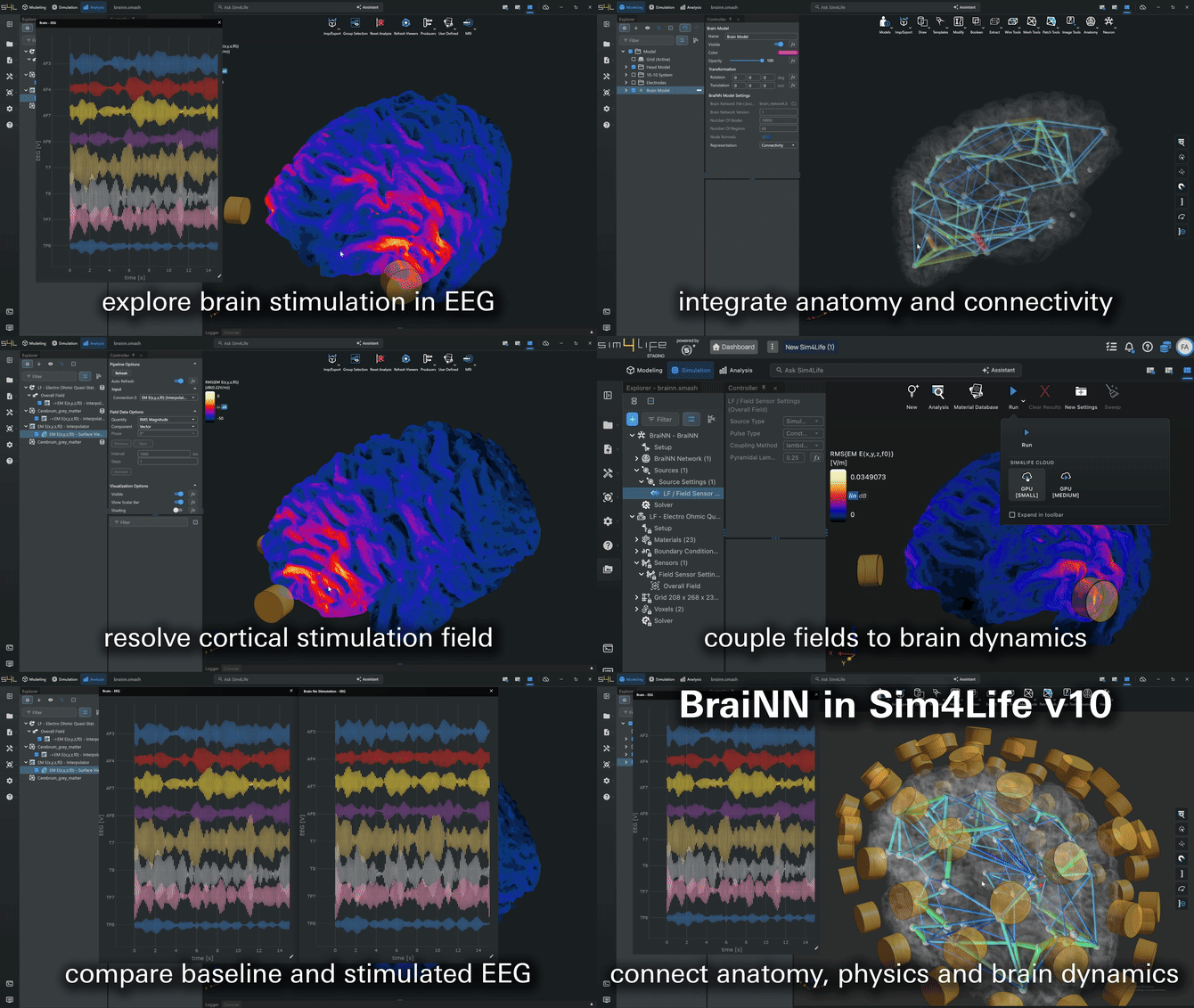
Please visit the deep-dive on sim4life.swiss to learn more.
Key questions the workflow addresses:
• How does a stimulation field change the simulated activity of a whole-brain network? Which spatiotemporal stimulation strategy has the desired impact on brain activity?
• How do those changes manifest in simulated scalp EEG?
• How do coupling strength, noise, and connectivity shape the outcome?
The BraiNN workflow in Sim4Life V10.0:
1. Load the model. Import the two files the tutorial provides: the head model with a 10-10 electrode array, and the BraiNN network definition. Display the network as a point cloud, as regions, or as a connectivity graph.
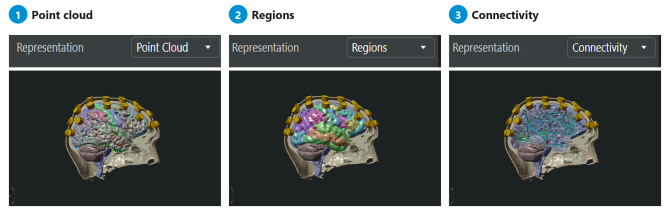
A whole-brain network model loaded in Sim4Life V10.0, displayed as a point cloud of nodes and as regions with structural connectivity.
2. Simulate the resting network. Create a BraiNN simulation, drag the network into the network settings, and run it with the default parameters. This is the baseline: the network's intrinsic activity without stimulation and the associated virtual EEG.
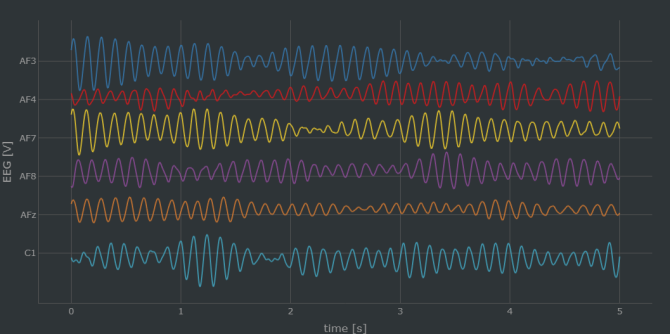
Simulated scalp EEG from the unstimulated network: Voltage traces at selected 10-10 electrodes.
3. Compute a stimulation field. Set two frontal electrodes (AF7 and AF8 in the 10-10 system) as the anode and cathode of a transcranial electrical stimulation montage. Apply +1 V and -1 V (arbitrary values) and run Sim4Life's Ohmic quasi-static solver.
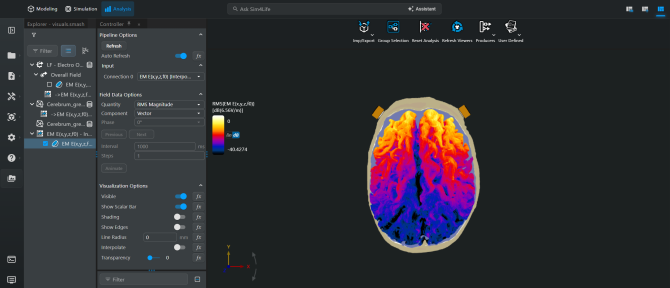
Electric field induced by a two-electrode transcranial electrical stimulation montage, computed with Sim4Life's Ohmic quasi-static solver in the same head model that defines the electroencephalography lead fields.
4. Couple the field into the network. Drag the overall field from the sensor extractor into the BraiNN simulation to use it as a source. BraiNN uses λE∥ coupling [7 – 9], described in the deep dive below; in V10.0 the input is constant in time.
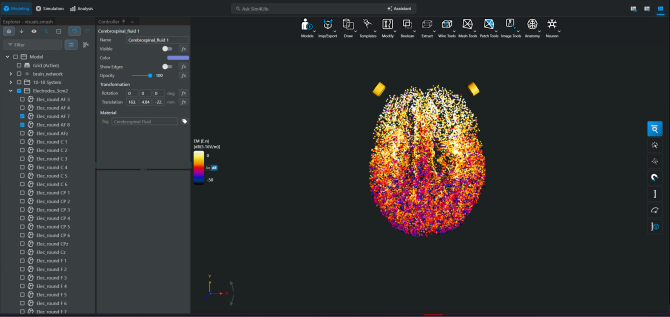
Magnitude of the stimulation field component aligned with the putative cortical columns, displayed on the cloud of network nodes.
5. Compare. Rerun with field coupling enabled and plot the simulated EEG of both runs or compare their spectra; the difference is the modeled effect of the montage. Keep the noise seed unchanged across the two runs so that any differences reflect the stimulation rather than the noise realization. Vary the montage, coupling strengths, synaptic gains, or noise level to explore how they affect the response.
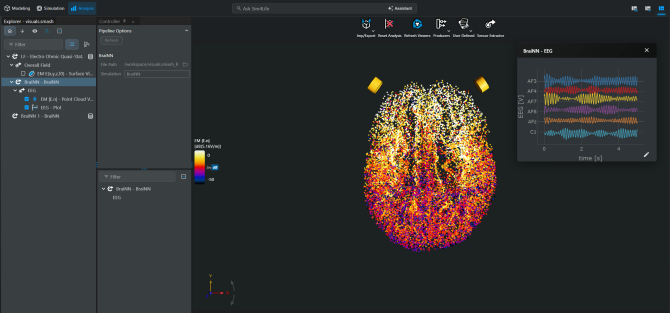
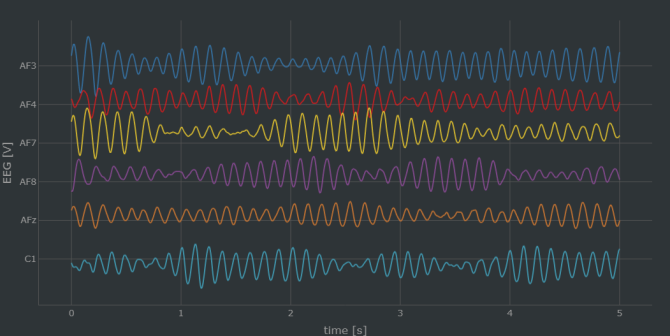
Example output from a simulation, showing a representative EEG signal for a given stimulation montage.
From Application Insight to Platform Refinement
Trust in a simulation platform depends on routine details: opening large projects, finding the right setting, understanding why a simulation produces unexpected results, and reproducing an analysis months later. V10.0 updates the interface and tools for performing all of these tasks.
A refreshed user interface for desktop and web:
Built on modern web technologies, the common web and desktop interface provides a responsive, consistent experience and supports faster delivery of new features. It brings the web platform's scripting environment to the desktop, adds search across tools, manuals, and tutorials, and offers guided modeling operations. Rich tooltips and embedded documentation keep help close to the task. Native support extends to Ubuntu Linux, with macOS to follow.
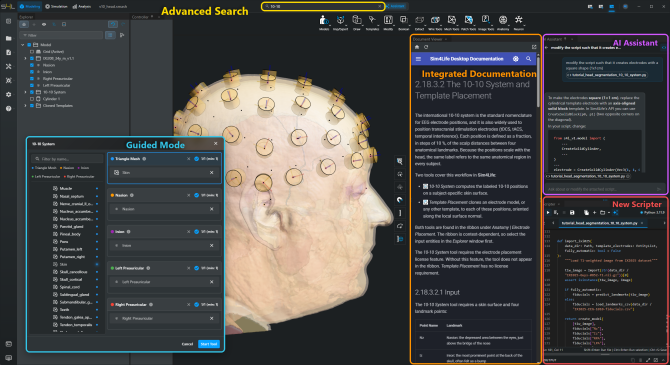
The refreshed interface in Sim4Life V10.0 brings integrated search, guided modeling, the web platform's scripting environment, and embedded documentation to desktop and web.
Guidance and diagnostics:
Warnings and errors appear at the relevant point in the simulation tree. The startup page brings together quick-start workflows, recent projects, tutorials, release notes, and frequently used resources.
Clear toolbar and sidebar organization, improved drag-and-drop feedback, and explicit lock states (for example, when voxels or results exist) make routine operations easier to follow. Material settings and Virtual Population model download and import have also been streamlined.
Sim4Life and Sim4Life Classic V10.0:
The previous interface remains available as Sim4Life Classic V10.0, fully supported alongside the updated interface. Existing projects and scripts continue to work in both. Classic will enter maintenance mode over the coming releases before it is retired, giving users time to move to the updated interface without losing productivity. A switch in the updated version restores a layout closer to Classic at any time. We recommend transitioning now and look forward to your feedback.
AI Assistant — available throughout the application:
The AI Assistant combines product knowledge with support for Python scripting, CAD modeling, simulation setup and review, and post-processing. The new "Ask Sim4Life" keyword enables context-aware adaptation of parameters, models, simulations, and grids through plain-language instructions. In a later version, users will be able to bring their own tokens for their preferred model provider.
Text-to-Simulation in practice. A use case demonstrates Text-to-Simulation. In a peripheral nerve stimulation study, the AI Assistant builds a 3D nerve from a labeled 2D cross-section and projects and fits cuff electrodes to its surface. To populate the nerve, iSeg delineates the fascicles, neuron entry points are seeded within each fascicle, and neuron models are routed along realistic 3D trajectories. This population step produces a simulation-ready nerve from a single request. Mesh refinement and convergence analysis follow, using best practices configured by our physics and biomedical experts. The results include visualization of action potential propagation along the nerve fibers.
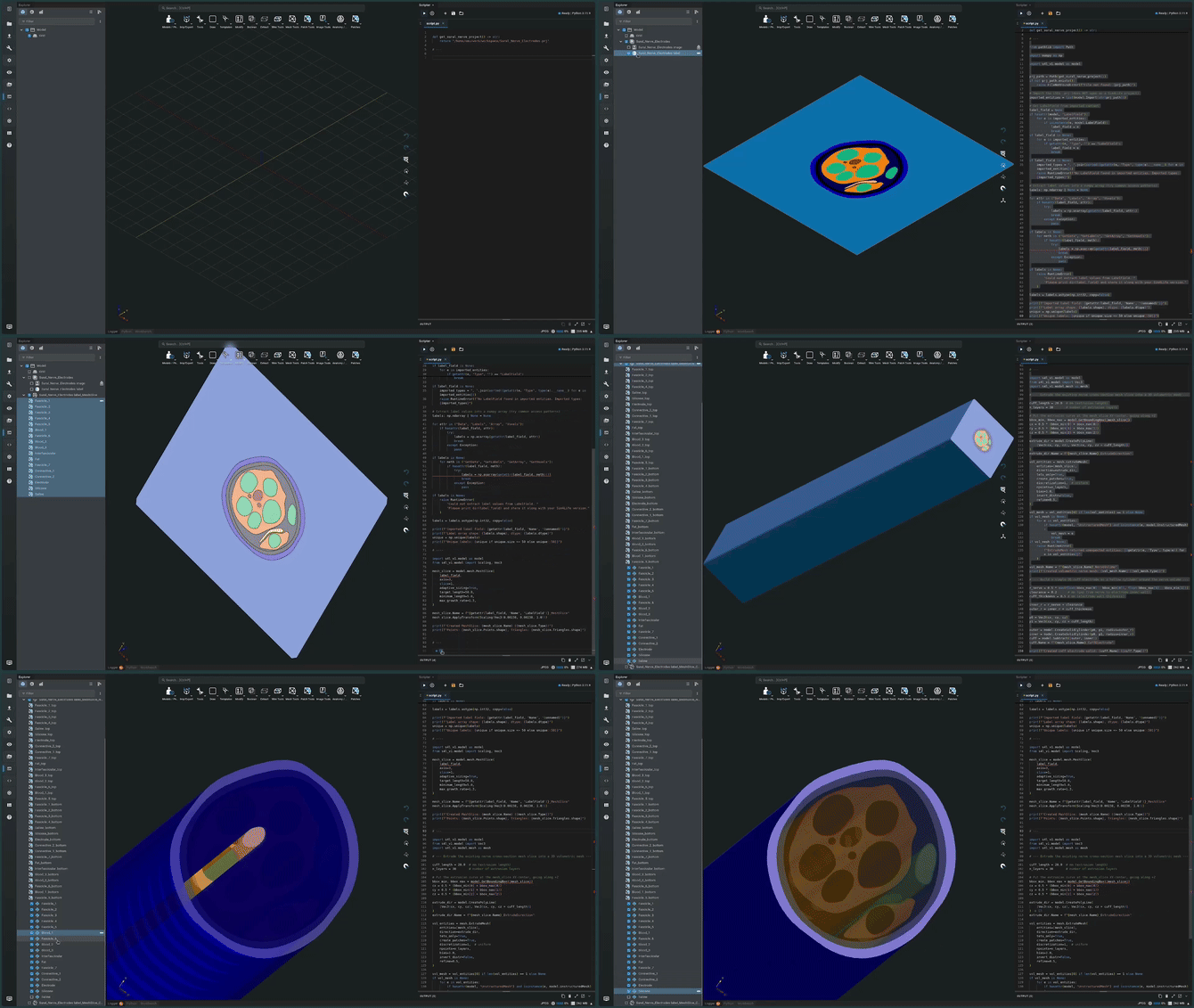
Action potential propagation along the fibers of a peripheral nerve model built by the AI Assistant in Sim4Life V10.0.
Localization — Sim4Life without language barriers:
AI-supported localization covers the entire interface, including menus, tooltips, and dialogs, as well as scientific and biomedical terminology, specific error messages, warnings, and alerts. Translations automatically stay in sync with new releases. English, Korean, Chinese, and Spanish are supported at launch, with additional major languages to follow.
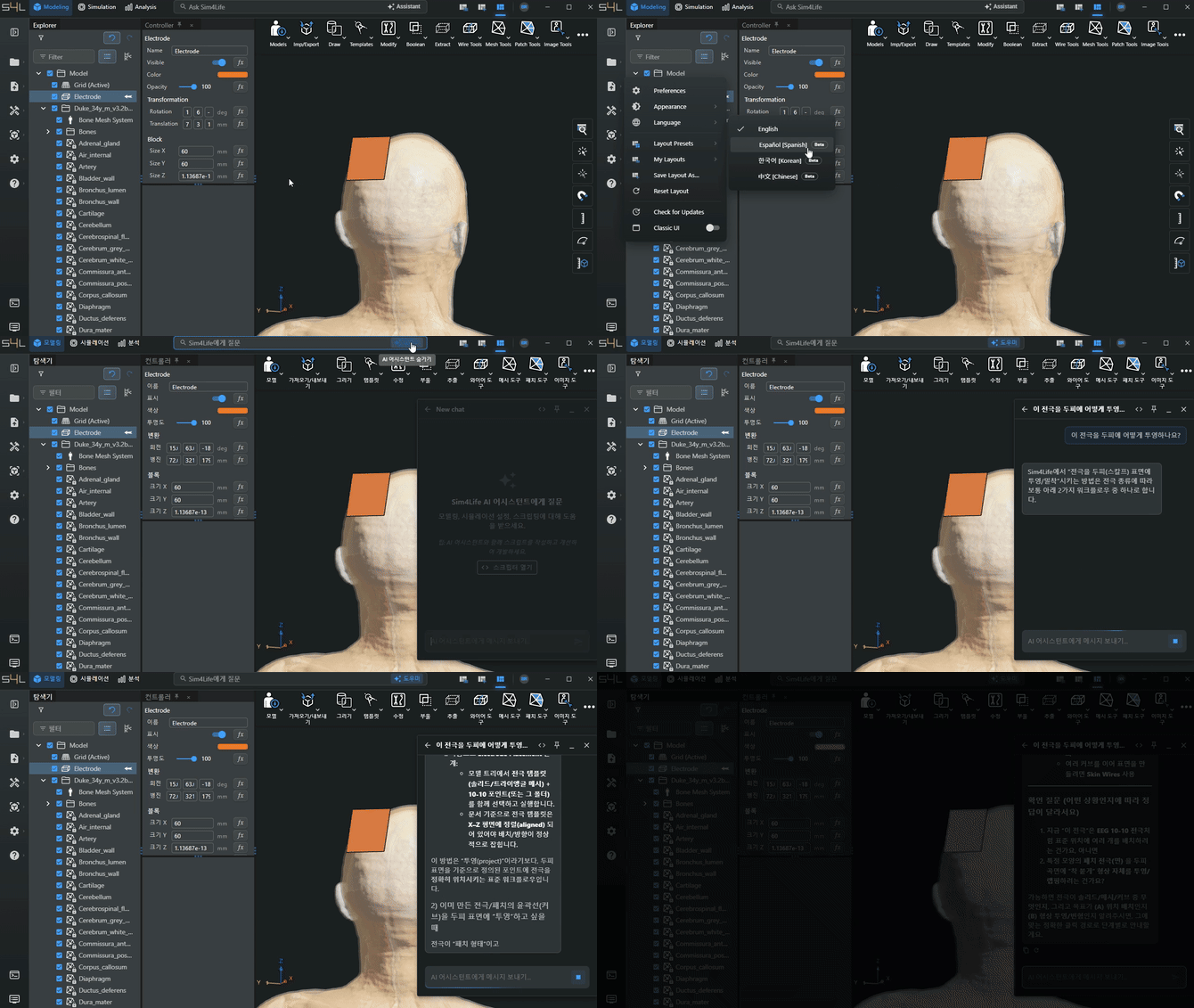
Sim4Life V10.0 in Korean: Interface, tooltips, and messages are localized.
ThermoReg — whole-body thermoregulation:
ThermoReg is a new whole-body thermoregulation simulator for assessing how thermal loads affect body temperature and heat exchange, with active thermoregulation and energy conservation. It implements the UTCI-Fiala multi-node model of human heat transfer and temperature regulation [12]. This model underlies the Universal Thermal Climate Index (UTCI), has been validated against the COST Action 730 database [13], and is widely used in the automotive, thermal-comfort, and sports industries. ThermoReg captures compartmental heat transport, arterial and venous counter-current exchange, respiration, and radiative and convective exchange. It also models sweating, shivering, vasoconstriction and vasodilation, and metabolic heat generation.
Coupled with Sim4Life's electromagnetic and acoustic modeling of in vivo power deposition, ThermoReg addresses energy-intensive applications such as MRI scanning, thermal therapies (e.g. hyperthermic oncology), 5G base-station exposure, and heat stress across varying climates. It resolves regional temperature evolution, thermoregulatory responses to time-varying exposure, and energy transfer/budgets in both transient and steady-state analyses. A functionalized version of the Virtual Population's Duke model translates simulated power deposition into compartmental heat sources for the whole-body model.
A hybrid simulator combining the UTCI-Fiala thermoregulation model with the anatomically detailed Pennes bioheat solver is in preparation. It will provide energy-conserving, multiscale modeling of active and passive thermal responses, with better handling of blood perfusion and transport.
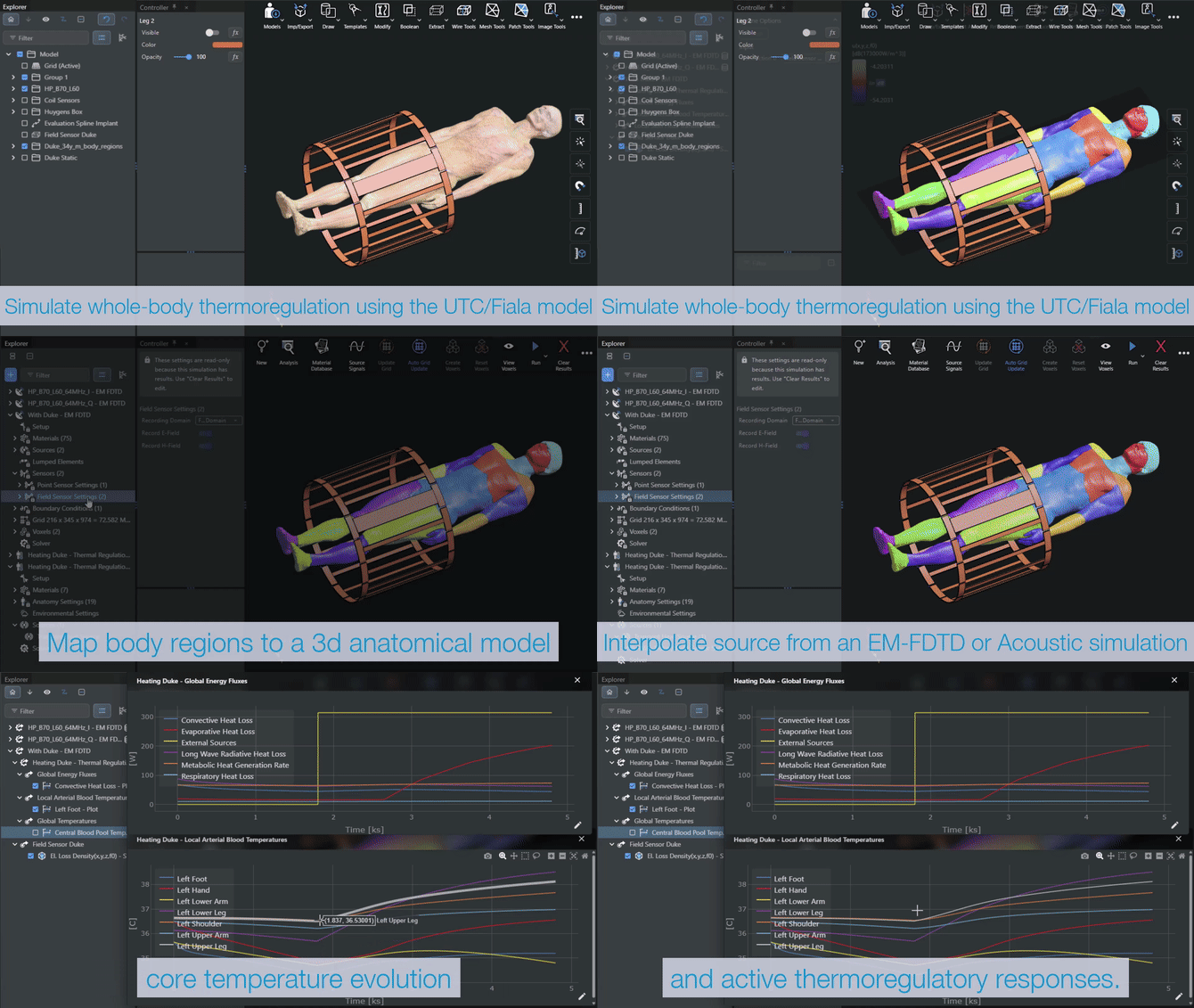
ThermoReg in Sim4Life V10.0 enables detailed modeling of human thermoregulation and thermal responses under varying heating conditions. Integrated body-region mapping and advanced global and local sensors provide comprehensive insights into temperature distributions, heat transfer, and thermoregulatory dynamics.
Low-frequency solvers — Consistent current normalization:
The low-frequency solvers now compute current fluxes to build up the admittance/impedance matrix directly which accelerates post-processing and avoids repeated evaluation of the impedance calculation. The new universal current normalizer adds robustness and flexibility in the choice of boundary conditions. Together, these changes provide a basis for multipolar exploration and downstream neural-response analysis, from single fibers to whole-brain coupling.
Multi-contact electrodes:
Every configuration from one solve. V10.0 computes the admittance matrix automatically for current- or voltage-driven multiport setups and passes it directly to coupled electrophysiology and thermal simulations – no manual extraction, no scripts. Sweeping or optimizing an electrode configuration against stimulation thresholds and temperature rise becomes a routine study, through the parameter sweeper or the Python application programming interface.
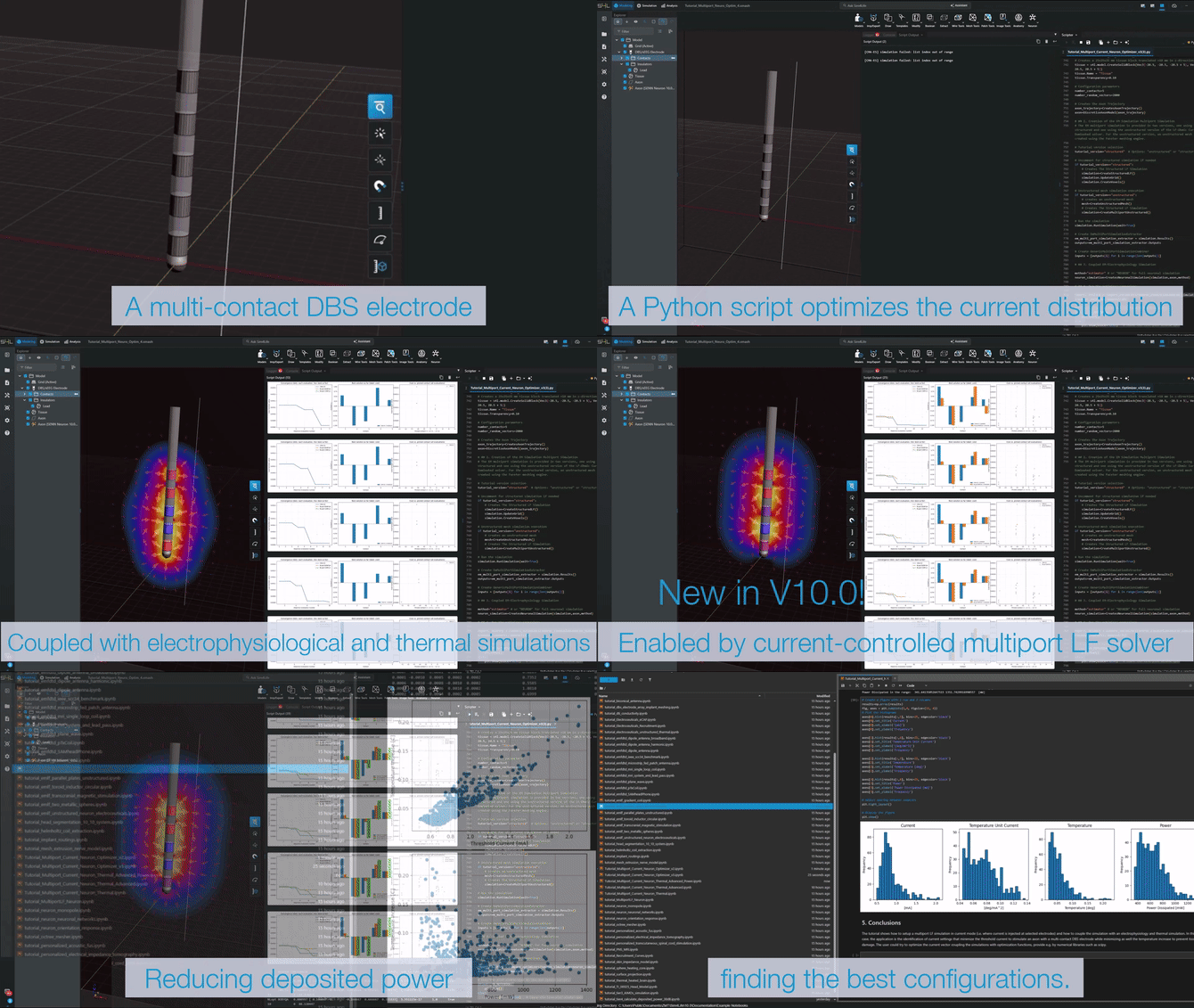
Python-driven multi-contact electrode optimization in Sim4Life V10.0: leveraging a current-controlled multiport solver to precisely control contact currents and calculate electric fields. Coupled electrophysiological and thermal simulations enable efficient, dynamic field updates during optimization. Key benefits include minimizing stimulation thresholds, peak currents, and deposited power through automated optimization. The workflow supports DBS, spinal cord stimulation, tES, and tIS applications.
Gridding and voxeling:
Finer control and direct use of segmentation label fields. V10.0 identifies the material or object that constrains the maximal stable time step, helping users balance resolution and runtime. Label fields, e.g. those generated by AI-based segmentation tools, can be imported as voxels and simulated directly, and additional entities such as implants can be inserted into the scene and voxelized. Optional refinement at solid interfaces is also supported.
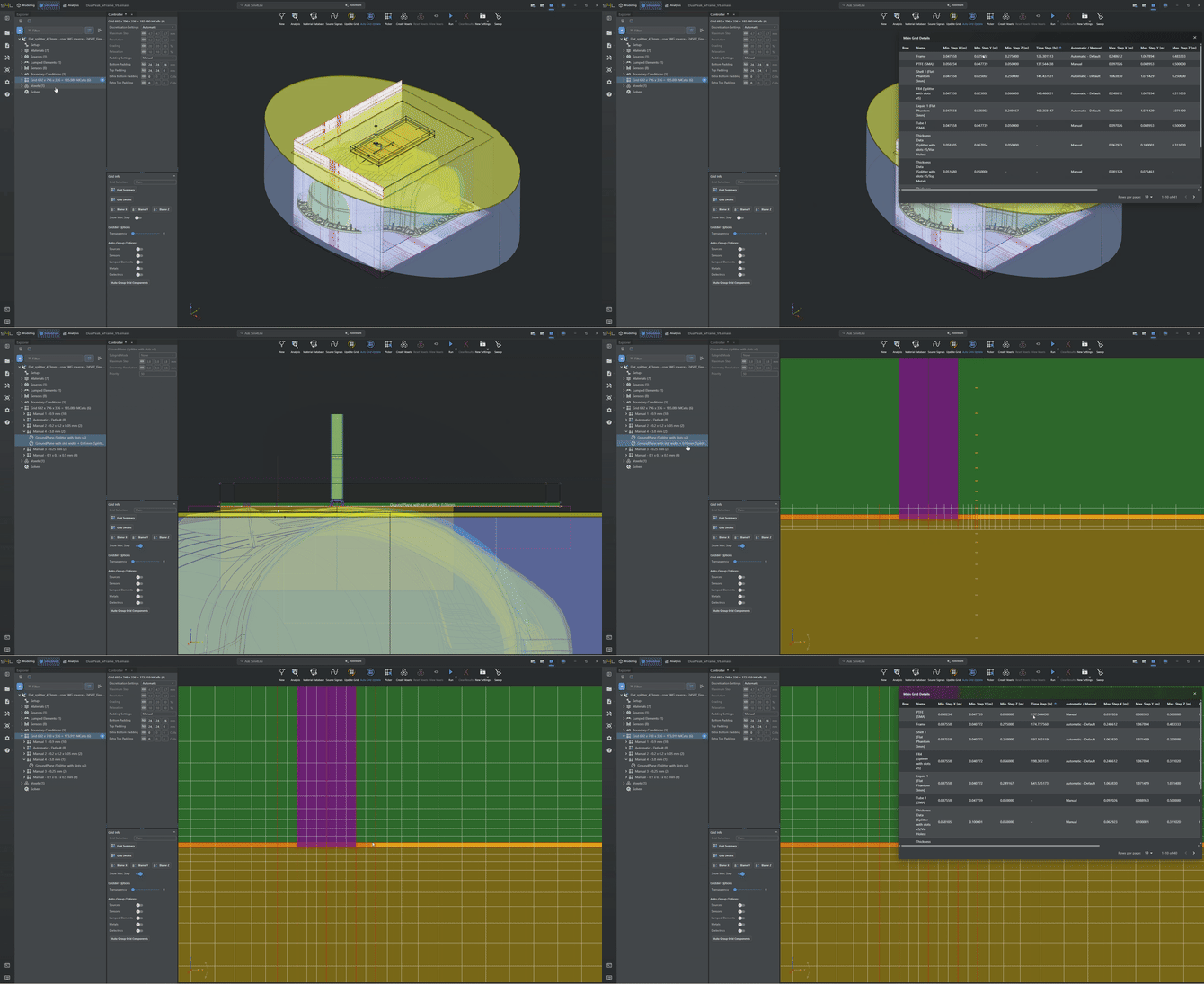
The voxel viewer in Sim4Life V10.0: Grid-control tools identify the materials or objects that constrain the stable time step.
Performance and cloud:
Simulations run faster and scale better; large projects open faster and large result datasets load more quickly. Tighter integration of the desktop application with the web platform keeps you informed of upcoming maintenance and releases and reports on running simulations in greater detail.
Sim4Life V10.0 integrates anatomy, physics, physiology, and whole-brain dynamics into a single, reproducible in silico environment. It also makes expert workflows accessible to users with limited modeling expertise. For R&D teams in neuromodulation, medical devices, wireless communication, and exposure compliance, it provides the integration, control, and speed needed to translate mechanistic understanding into clinically relevant designs and certifiable exposure assessments.
Customized Research
Interested in producing regulatory-grade model evidence, running in silico studies, or developing a Sim4Life-based planning tool for your device, protocol, or patient population? Contact the IT’IS Customized Research experts to explore customized solutions for your application.
Sim4Life V10.0 is available today on all our cloud platforms for commercial users, researchers, and students.
The Desktop Installer is available here. Sim4Life Classic V10.0 is available here for the transition period.
For further information, please email us at s4l-sales@zmt.swiss or call +41 44 245 9765.
Kind regards,
The Sim4Life Team
IN SILICO WE TRUST
REFERENCES
[1] Sanz Leon P, et al. The Virtual Brain: A simulator of primate brain network dynamics. Front Neuroinform. 2013;7:10. https://doi.org/10.3389/fninf.2013.00010
[2] Jirsa VK, et al. On the nature of seizure dynamics. Brain. 2014;137(8):2210-2230. https://doi.org/10.1093/brain/awu133
[3] Wang HE, et al. Delineating epileptogenic networks using brain imaging data and personalized modeling in drug-resistant epilepsy. Sci Transl Med. 2023;15(680):eabp8982. https://doi.org/10.1126/scitranslmed.abp8982
[4] Wang HE, et al. Virtual brain twins for stimulation in epilepsy. Nat Comput Sci. 2025;5(9):754-768. https://doi.org/10.1038/s43588-025-00841-6
[5] Fasse A, et al. BraiNN: A modern simulator for clinically feasible personalized whole-brain network modeling. bioRxiv. 2026. https://doi.org/10.64898/2026.07.08.737156
[6] Jansen BH, et al. Electroencephalogram and visual evoked potential generation in a mathematical model of coupled cortical columns. Biol Cybern. 1995;73(4):357-366. https://doi.org/10.1007/BF00199471
[7] Molaee-Ardekani B, et al. Effects of transcranial direct current stimulation (tDCS) on cortical activity: a computational modeling study. Brain Stimul. 2013;6(1):25-39. https://doi.org/10.1016/j.brs.2011.12.006
[8] Merlet I, et al. From oscillatory transcranial current stimulation to scalp EEG changes: A biophysical and physiological modeling study. PLoS ONE. 2013;8(2):e57330. https://doi.org/10.1371/journal.pone.0057330
[9] Kunze T, et al. Transcranial direct current stimulation changes resting state functional connectivity: A large-scale brain network modeling study. NeuroImage. 2016;140:174-187. https://doi.org/10.1016/j.neuroimage.2016.02.015
[10] Ableidinger M, et al. A stochastic version of the Jansen and Rit neural mass model: Analysis and numerics. J Math Neurosci. 2017;7:8. https://doi.org/10.1186/s13408-017-0046-4
[11] Plonsey R. Reciprocity applied to volume conductors and the ECG. IEEE Trans Biomed Electron. 1963;10(1):9-12. https://doi.org/10.1109/TBMEL.1963.4322775
[12] Fiala D, et al. UTCI-Fiala multi-node model of human heat transfer and temperature regulation. Int J Biometeorol. 2012;56(3):429-441. https://doi.org/10.1007/s00484-011-0424-7
[13] Psikuta A, et al. Validation of the Fiala multi-node thermophysiological model for UTCI application. Int J Biometeorol. 2012;56(3):443-460. https://doi.org/10.1007/s00484-011-0450-5


